

For a long time, we operated under a clear binary: Schools are where you learn, and businesses are where you work.
While the scales have been tipping slowly for years (with companies launching internal L&D programs and schools adopting project-based learning), the recent acceleration around AI has practically flipped the scales overnight.
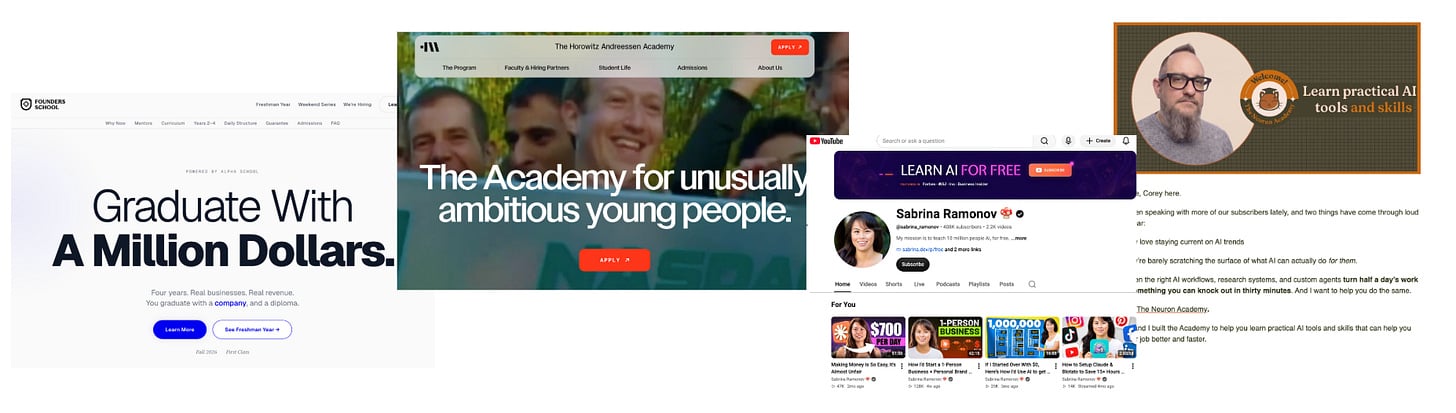
It feels impossible to open an inbox without seeing another venture or profitable business launching an educational ecosystem. Founders School is promising million-dollar payouts to teenagers who launch businesses. Andreessen Horowitz recently announced the Horowitz Andreessen Academy to train high-potential talent. Meanwhile, AI communities are finding that their true monetization engine isn’t the tooling itself, it’s the teaching. (see: The Neuron Academy, and builder-educators like Claire Vo and Sabrina Ramonov).
This is where a significant portion of my own work with Build First has shifted.
Increasingly, my focus is on helping deep domain experts or functional teams get real work done using AI. This summer, we piloted two different versions of “Build First AI School” for businesses, with 4-8 week cohorts of weekly classes to help non-technical people become builders. Over the next month, I’m running an AI workshop for HR leaders in San Francisco, a remote bootcamp for finance professionals, and a legal hackathon in NYC.
The deeper I get into these specific verticals, the less generic the AI instructions become. When last year I was teaching people how to “click the plus-sign to attach a document to your chat conversation,” this year I’m increasingly finding myself inserted directly into the front lines. And I’m learning more too. After all, to teach someone how to use technology to solve HR or finance problems, you have to understand enough about HR and finance to map out their problem space well enough to build a real solution.
Last week alone, I ran two back-to-back workshops for entirely different cohorts: Geologists on one day, battery experts the next. The context shifting is wildly unsettling, but the practice of building remains remarkably consistent. In other words, the educator and the practitioner are merging.
The other interesting thing about this particular moment is that the power right now lives among individuals and groups with the greatest capacity for experimentation. This gap is dizzying.
On the one hand, my Twitter and LinkedIn feeds increasingly make it seem like if you aren’t starting your own business and running your own agentic swarm, you’re already behind. Gary Vaynerchuk posts content 4-6x a day encouraging people to quit their day jobs and start something new, Greg Eisenberg’s Idea Browser gives away free business ideas to anyone willing to pay attention, and newsletters like Nate’s Newsletter, Lenny’s Newsletter, and Ben’s Bites each topple hundreds of thousands of subscribers with daily builds.
On the other, traditional institutions inherently recognize that they have a lot more to lose when a few erratic agents go off the rails and are opting to move slower as they grapple with a massive question: What does it mean to incorporate AI in a way that keeps our proprietary data safe?
Unfortunately, this is creating a scary bifurcation in AI upskilling: If you work at a traditional institution, you are less likely to be exposed to the cutting-edge frontier tech that the next generation will be built upon. If you have a manager today who’s opting out of learning this stuff, it’s going to come at the expense of your own ability to learn how to adapt for the what’s next.
Last week, on the train ride to a corporate training session, my co-facilitator and I got an alarming notification: The exact software product we were hired to teach was being sunset. The announcement had gone live that morning. We had to stand up and introduce a new tool in the same breath that we announced what they would need to migrate it to next.

This innovation explosion is not only causing complete chaos among leadership teams, but it’s leading individual contributors and senior leaders alike to ask themselves the hard question: “Do I stay in a work environment that won’t move as fast as I can?”
The answer, increasingly, is no. In the past six months, two past corporate clients left their jobs for more forward-thinking teams elsewhere, and I know two more with one foot out the door. Some others have decided to bypass the bureaucracy completely and pay out of pocket for me to teach them things their companies won’t. In other words: The demand to learn this stuff couldn’t be higher.
And yet.
Public school systems (including New York City, where I live) are increasingly opting to hit pause on bringing AI into classrooms. In a district serving 850,000 students, you can understand why a safety-first, risk-averse approach feels like the only viable option for leadership. But at the individual level, I can’t honestly look any young person in the eye and tell them they’d be better off not learning this stuff.
There’s something unsettling about all of this.
When public institutions pause while private capital accelerates, we create a dangerous vacuum. We’ve seen in web 2.0 what happens when we let our education be shaped only by the people who have the funding, resources, and access get to sit in the room and control the narrative. If schools push pause, but businesses start schools anyway, what’s the end game?
Last week, I ran an AI build session for master’s students in Technology Management at Columbia University. After the class, I had a conversation with a woman who had spent her entire career as a software product manager. She had been playing around with vibe coding and dabbling enough to know exactly what she wanted to build. But like so many non-engineers, she had been told for years that she needed a technical counterpart to build anything real.

I recognized this feeling right away since it’s the same thing I felt last year, too. And I told her just as much: She was waiting for a permission slip that might never come.
Notably, someone like her is not the target audience for a program promising teenagers a $1M payout at graduation. But she represents the exact persona we need more of right now: People who are deeply close to real problems, who have lived enough to know what their communities actually need.
When AI allows domain experts to turn ideas into software in real time, everything changes. And I’ve seen this happen in real time. It takes hours, not months, to flip the switch.
Earlier this year, I helped a seasoned educator and non-profit leader in North Carolina build an MVP for a math tutoring app she’d been conceptualizing for years. She had the design schemas on paper, she had wireframes and a project plan ready to go, she just lacked the technical execution. In a single two-hour session using Replit, we spun up a functional prototype she could share internally the very next day.
It completely reframed how she viewed building. All at once, the question shifted from “Could someone build this software for me?” to “Who else needs this, and how fast can I get it to market?”
To be clear, I don’t believe every school will become a startup incubator, just like I don’t believe every business should become an academy. There is plenty of gray space in the middle. But it’s time we acknowledge that the line between learning and working is no longer binary and that the people closest to the problems are finally the ones holding the tools to solve them.