
Last year, I decided to go all in on myself and start Build First, an AI learning lab that teaches everyday people how to build their own software and tools.
In its first full year, Build First has grown from a one-person operation into a business that supports enterprise clients across over a dozen industries.
Today, I run the whole business through a collection of custom-built tools and workflows that I made without writing any code by hand. I would not have known how to create these systems even a couple of years ago.
Ultimately, AI gave me the tools, the confidence and the leverage I needed to dive into entrepreneurship for myself. Since then, I’ve taught hundreds of business owners how to build their own business operating systems.
Along the way, I’ve learned that becoming an AI-native builder requires two things:
Understanding what’s technically possible; and
Overhauling your habits around how work gets done.
In this post, I’ll share both.
First, I’ll walk you through the system I’ve built for myself. Then I’ll show you what an AI-native week actually looks like for me and how you can get there, too.
At Build First, we sell technology agency.
Companies bring us in when they want to activate their employee base and unleash a wave of AI-powered building. Each hands-on engagement is accompanied by training software, tools, and materials tailor-made to each client.
Yes, the software behind that system is also powered by AI. But the more interesting part is the stuff that happens behind the scenes.
Before a client books a workshop or a hackathon with us — or after the engagement closes — there’s work to do just to keep the lights on.
It’s all the little things: Remembering to follow up with clients you pay you late, reconciling your books at the end of every month, tracking which clients are on which contract terms. This is the annoying, tedious, soul-crushing stuff that brings down a lot of business owners.
I’m not going to lie: As a highly creative person, this tedious work almost broke me last year. But this year, I built my way out of it with my own Build First OS.
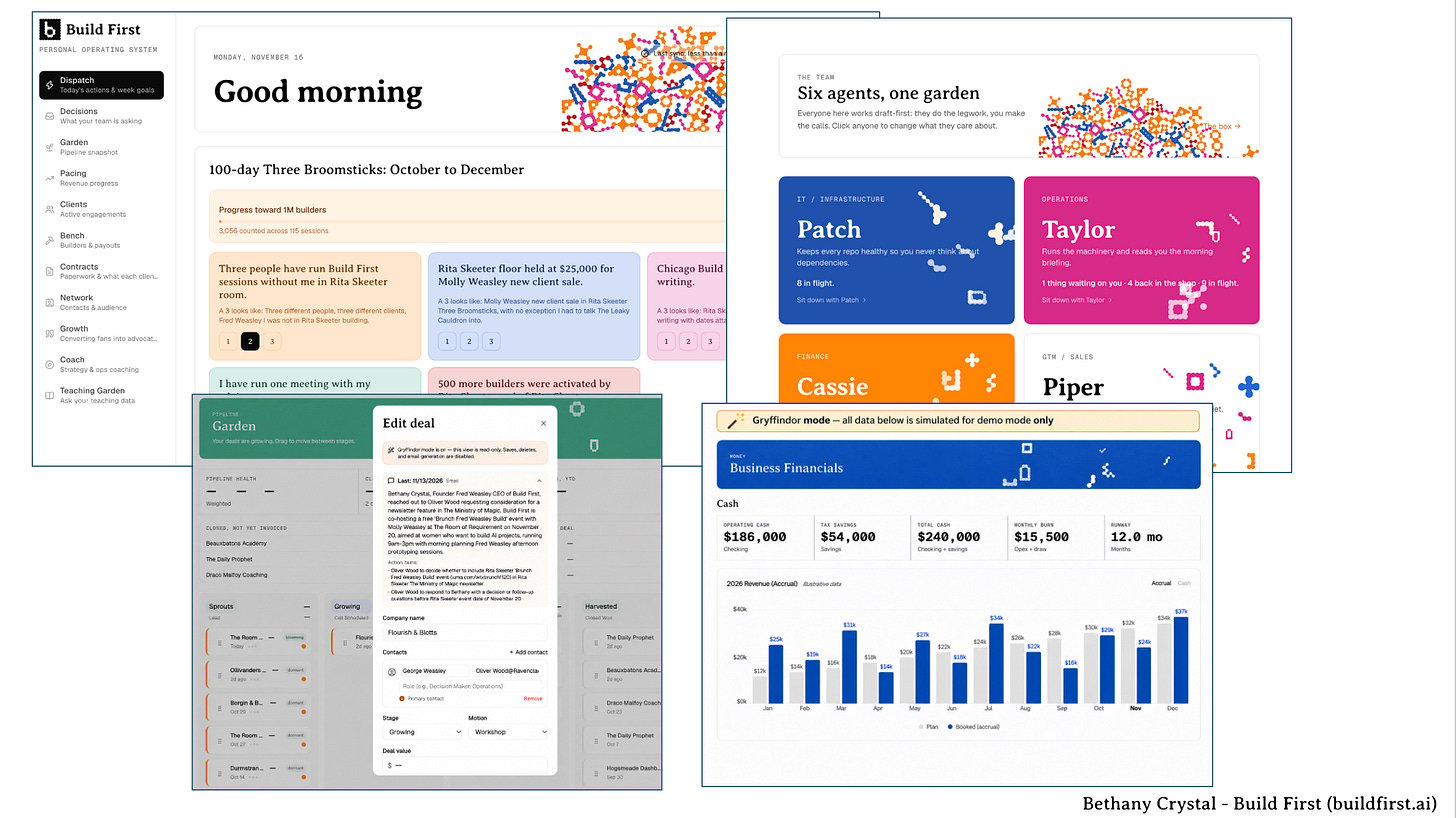
Today, this system…
Powers my sales pipeline
Manages my client and contractor invoicing invoicing
Runs my financials, expense tracking, and projections
Keeps track of contracts, commitments, and key decisions
Stores contact details from my entire network
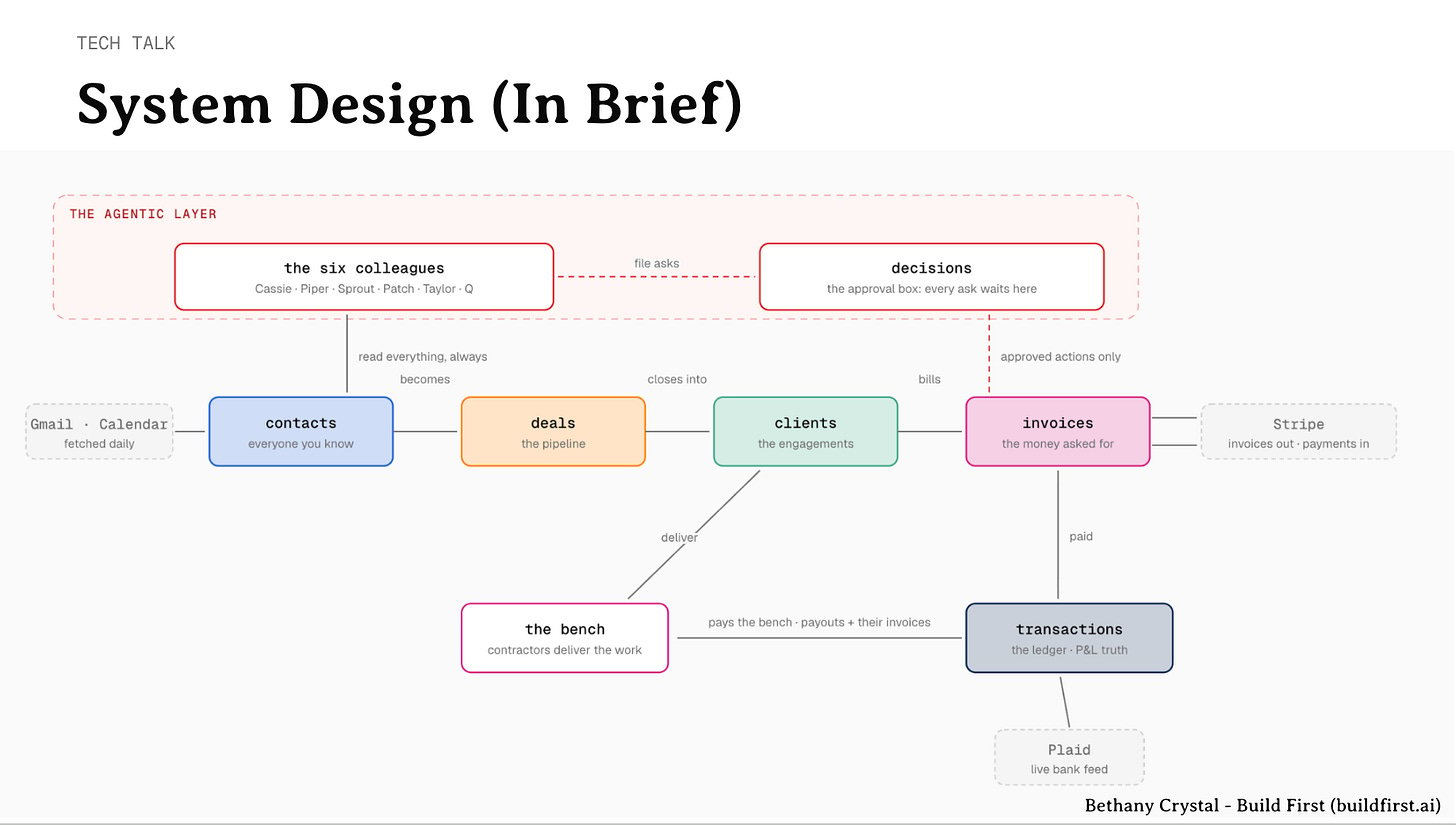
At face value, this system is pretty simple. I keep track of the business basics: Contacts, deals, clients/contractors, and invoices.
I connected this OS to my email, my calendar, my Github, and my banks (via trusted intermediaries — Stripe and Plaid). I set goals every week for what I want to get done. And my AI agents help me keep things moving. And that’s…it.
The best part about this system is that it stays with me.
Yes, Claude helped me build the MVP, but my business data doesn’t live in Claude. It lives in my own system, on my own database, and on my own computer.
This means I can pick it up, pull down the Github repo somewhere else, and keep working on it somewhere else, with another AI coding agent, an open source harness or one day, on my own locally hosted models.
To me, this is just about the most important thing ever as a small business owner: Making sure the stuff you build stays with you. Period.
As I’ve learned, there are only two things that matter at the early prototype stages of building something new:
Is the thing you made useful to you right now?
Is it so useful to you that you’ll be willing to keep coming back to it daily to keep iterating on it?
As it turns out, this is easier said than done.
The Build First OS was probably the 30th app I’d built with AI. But it was the first thing I built that I needed so desperately that I came back to it every single day.
You see, back in January, I had $30k of bookings but only $37 in the bank account. While I could see around the corner to the other side, I started this year with a paranoid mantra:
I knew that AI could likely help me with this, but I wasn’t exactly sure where to start.
There’s a framework we teach at Build First called POP-IT, which we established in partnership with Decoded Futures back in 2024. Here’s how it goes:
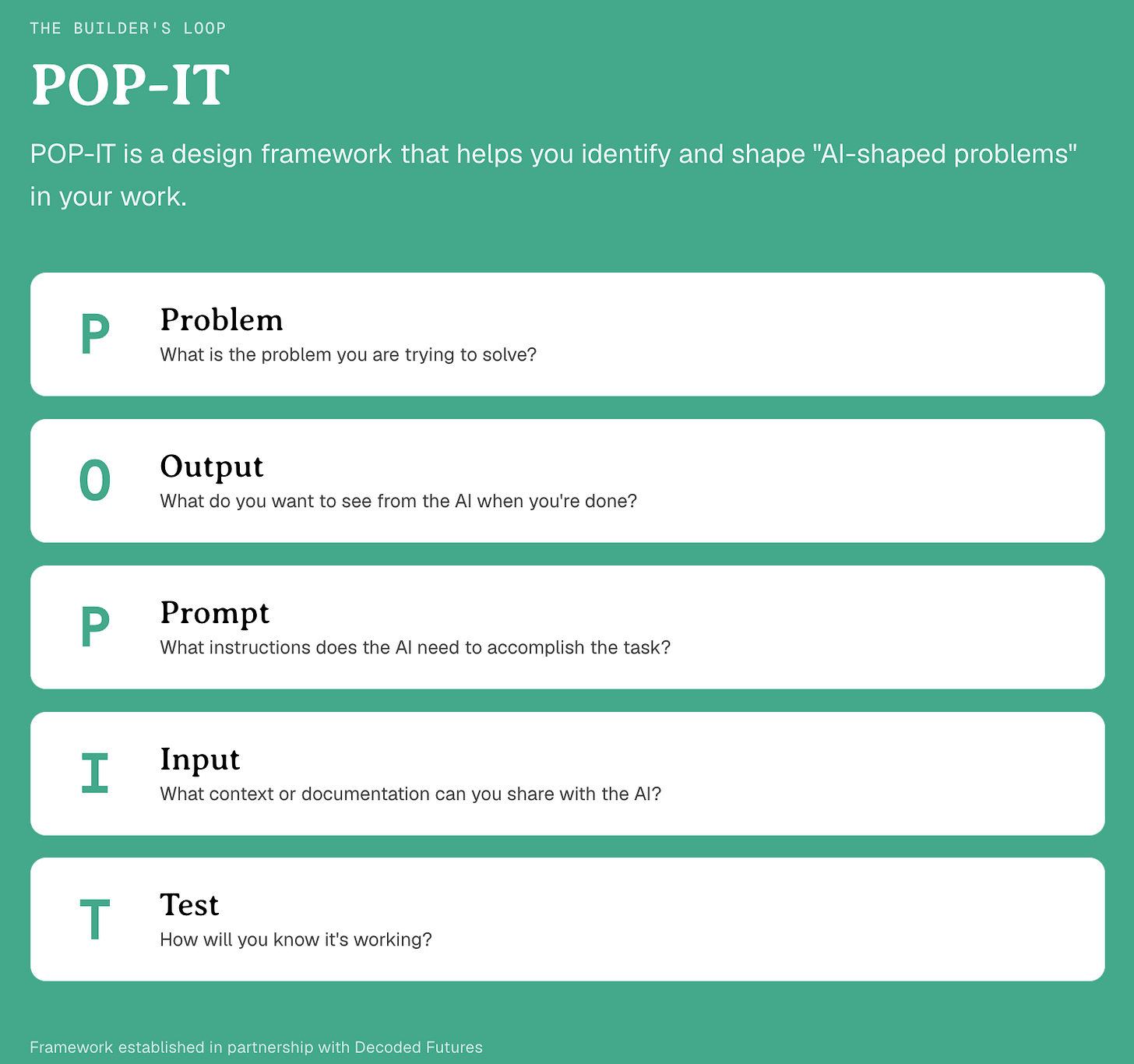
This matters more than you think. Pick the wrong problem and you’ll never understand how to integrate AI-native work into your actual day-to-day. Pick the wrong output and you waste cycles in a rabbithole to build something that doesn’t actually solve your real problem.
Today at Build First, we spend 90% of our energy helping people pick the best first build. So I put my own methodology to work.
Here’s what I came up with:
Problem: “I’m dropping leads in my sales pipeline because I’m losing track of where I’m at in each conversation.
Output: “Help me build something to keep better track of where I’m at with all of these conversations.”
Prompt: “Read through all of these materials and help me think through what we can build together to solve this problem.”
Input: “Use my current sales pipeline, my product offerings, and my Build First business strategy document to learn more about me and my process. Then connect to my inbox and help me create a real-time snapshot of where things stand with live accounts.”
Test: “Show me where you think my pipeline is today, I’ll tell you if you’re right.”
That’s how one evening in January led to an MVP of a business dashboard that looked like this:
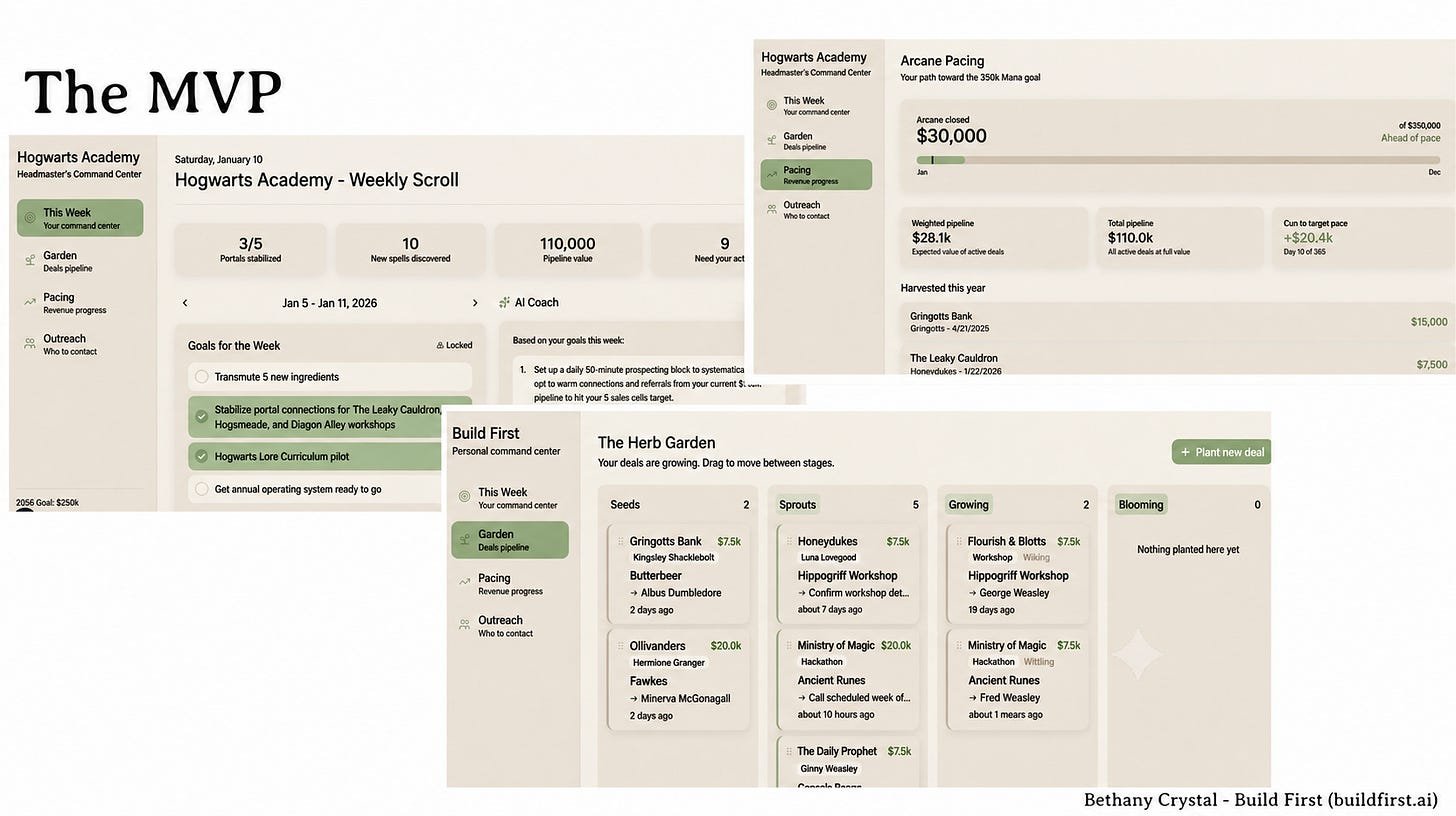
You might think this looks like AI slop. You’d be right.
But guess what? It didn’t matter what it looked like. It mattered that it worked.
And this ugly dashboard solved the problem the exact problem I had at the time: It immediately surfaced seven dropped leads from my leaky pipeline.
That’s a pretty good reason to keep working on something.
Nearly one year later, this AI-powered operating system that knows as much about my business as I do. I literally can’t work without it.
The thing that makes the Build First OS differentiated isn’t how I started it, it’s how I continue to improve it.
A lot of people complain that learning how to use AI in this way takes too much time. While I agree that there’s a steep learning curve, this isn’t because the tools are tricky to learn — it’s because the tools invite us to rewire our professional habits around the way we work.
Most of us are willing to do the former, but not the latter.
Through much trial and error this year, I’ve learned that I need at least 3 blocks of 3 hours of uninterrupted time to maximize my efficiency and productivity with AI tools.
Why three hours? It’s enough time to get through a completed build cycle, get a proof of concept out the door, and tweak it until it’s good enough.
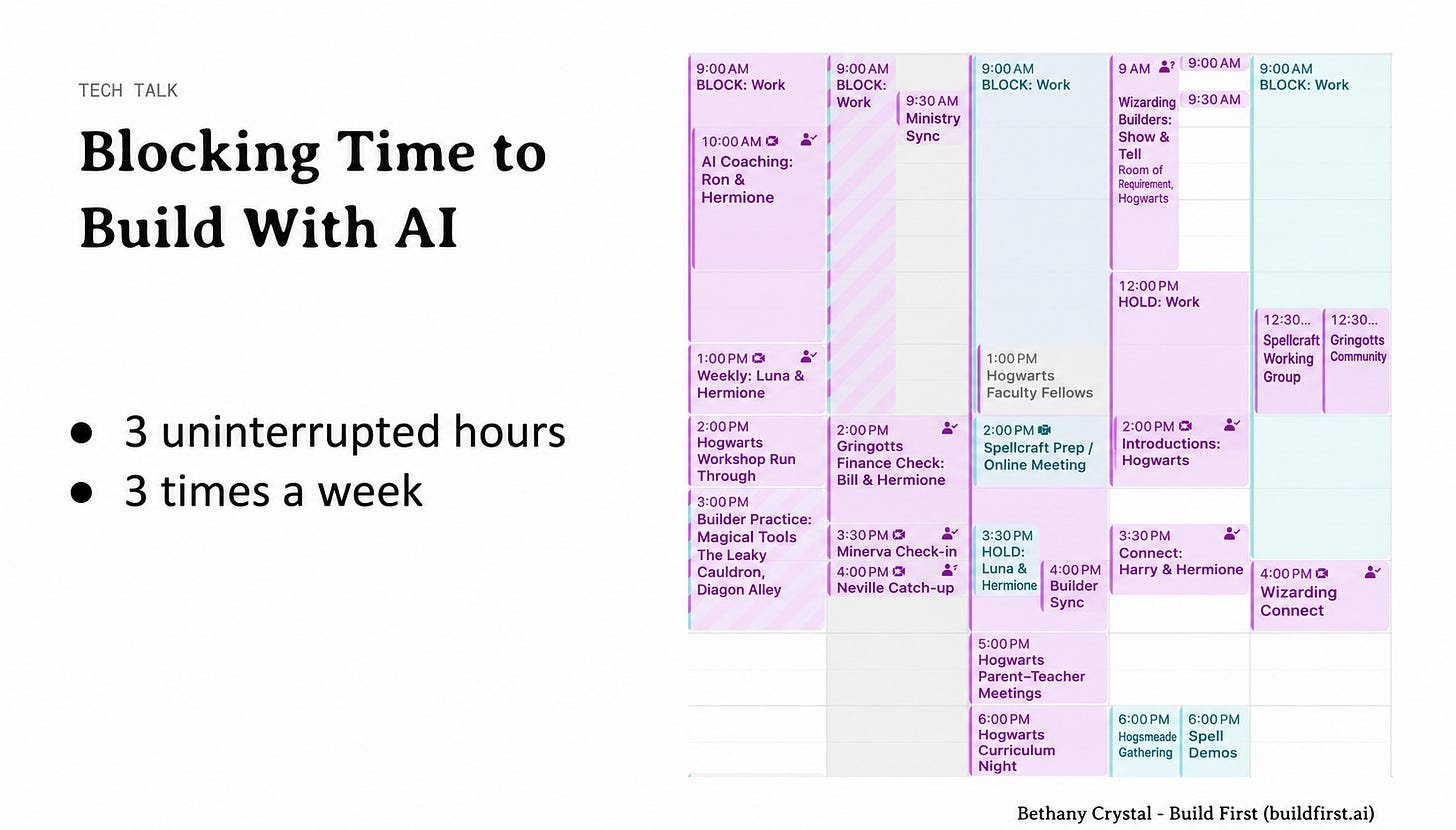
Now that I’ve gotten used to this cadence, I am getting better at multi-tasking. So I don’t just work on one thing at a time, I work on a half-dozen.
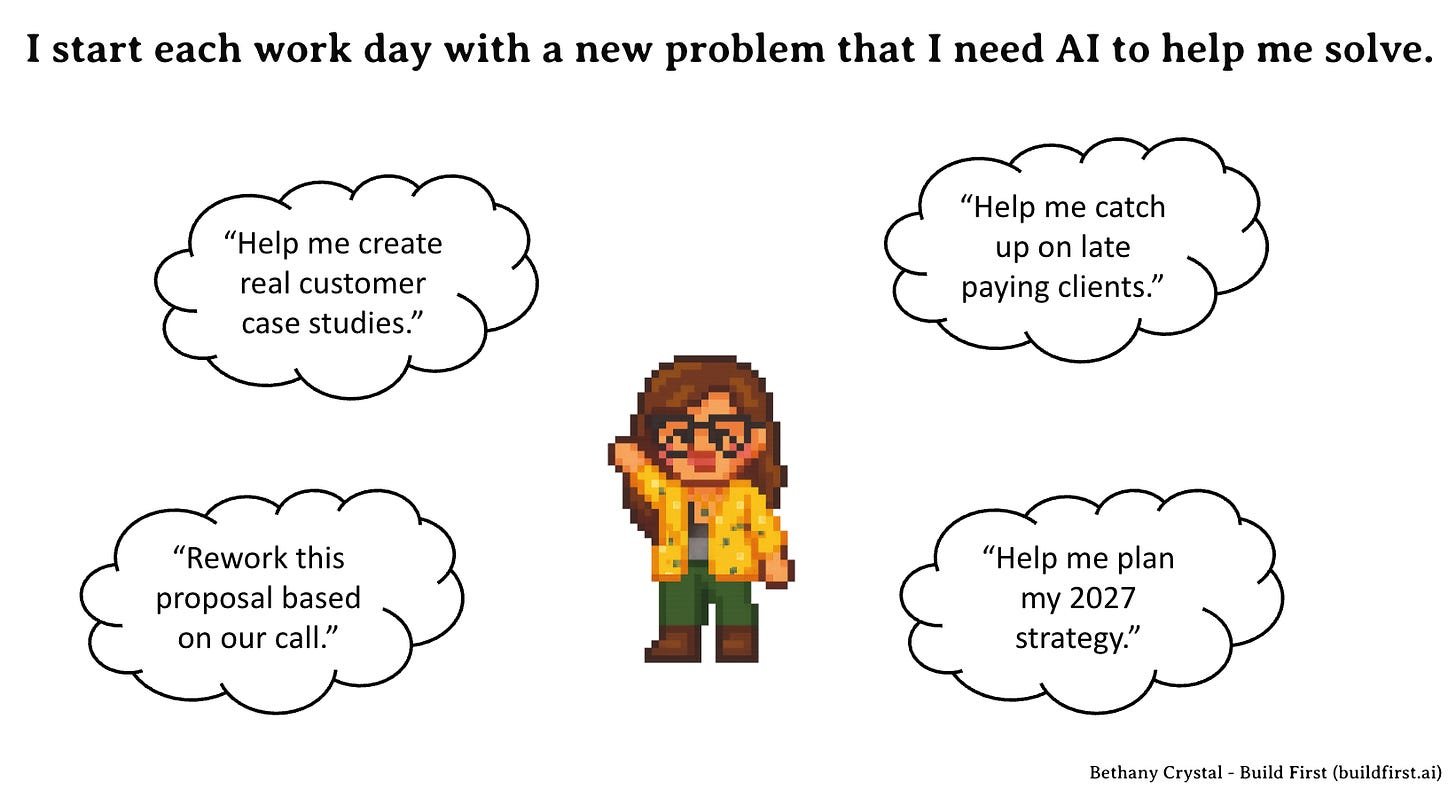
Every day I wake up, and I open my AI coding agent (these days, it’s Claude Code) and ask, “What is the most important job I need to get done today?”
Then, me and Claude get to work.
I like to use Claude Code’s command line interface inside of Cursor, which lets me see all of my simultaneous sessions and also give me visibility into the entire file architecture of my system. (Note: I didn’t start being this comfortable with this “scary terminal view,” I’ve acclimated over time. Start in the Claude desktop and work your way there.)
Typically I’ll start 5-6 sessions at once (each on its own worktree), and then those sessions power me through the week by building alongside my real work, in real time.
Throughout the week, I’ll come back to these sessions, call out changes, invite my AI to surface updates from call transcripts, and build disposable apps and artifacts as worksheets to help me plan, collaborate, and ideate with my AI in real time.
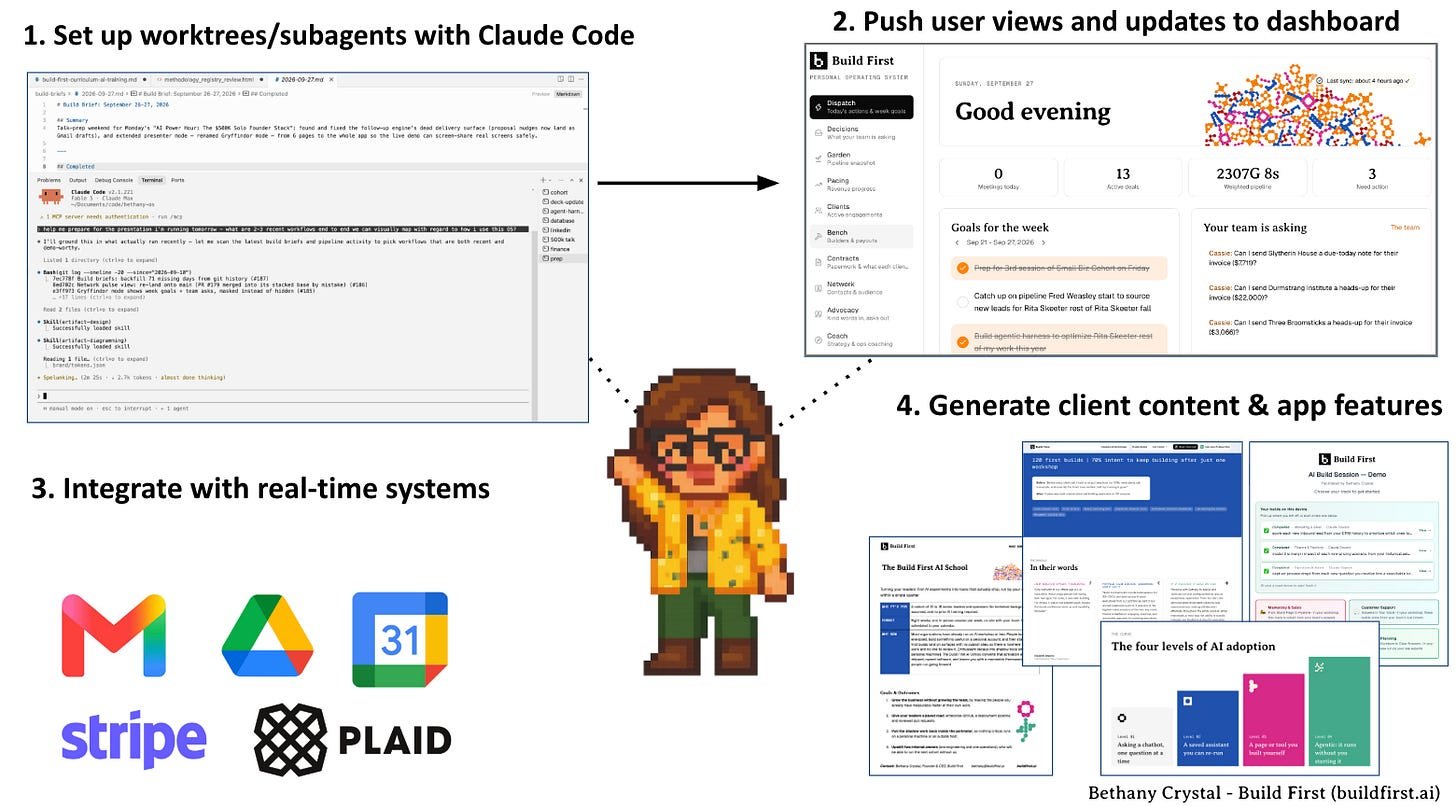
This process is how I generate all of the materials needed for every workshop that we run, every piece of content that we create, and every update to our marketing site.
Over time, I’ve canceled subscriptions to 8 different SaaS products, opting instead for API keys different developer accounts that interact with everything as the “glue” in between these layers.
Today, I can keep my whole business operational with about 10 hours of operational administration a week. The rest of the time is spent on service delivery, business development, and 1-1s with people on the growing Build First bench of facilitators.
Getting started on a good first build is key. But keeping it up is just as important. As an AI-native business owner or operator, you need both.
Part of why I think this is a really inspiring opportunity for entrepreneurs right now is because all of us are starting from zero with AI. You don’t need to be an expert. You just need to commit to being AI native, and learning along the way.
The truth is that my operating system is deeply imperfect. It gets things wrong. It breaks its own automations. It even contradicts itself sometimes. I’m surprisingly okay with this.
I’ve experimented with plenty of out-of-the-box solutions that promise instant “AI magic.” But I’ve found that the more control I give up over how my systems are built, the less I understand how they work…and the less confident I feel improving them myself.
Just like humans acclimate to working with other imperfect human colleagues, I’ve learned how to adjust to the parts of the system that break, fix the parts that really drive me nuts, and sunset the components I don’t need anymore.
Over time, this has taught me how to exercise human judgement in an AI-invented landscape. It also keeps me attuned to the boundaries of what’s possible. (For example, I still require human sign-off before any piece of content, contract, or financial statement hits a client.)
The biggest change AI has made in my life isn’t that I can build software without knowing how to code. It’s that I’ve stopped accepting the limitations of the tools available to me.
When something doesn’t work, I no longer assume I have to find another product, hire someone, or live with the problem forever. I know I can build a better version myself.
And every time I do, I become a little more capable of solving the next problem.