
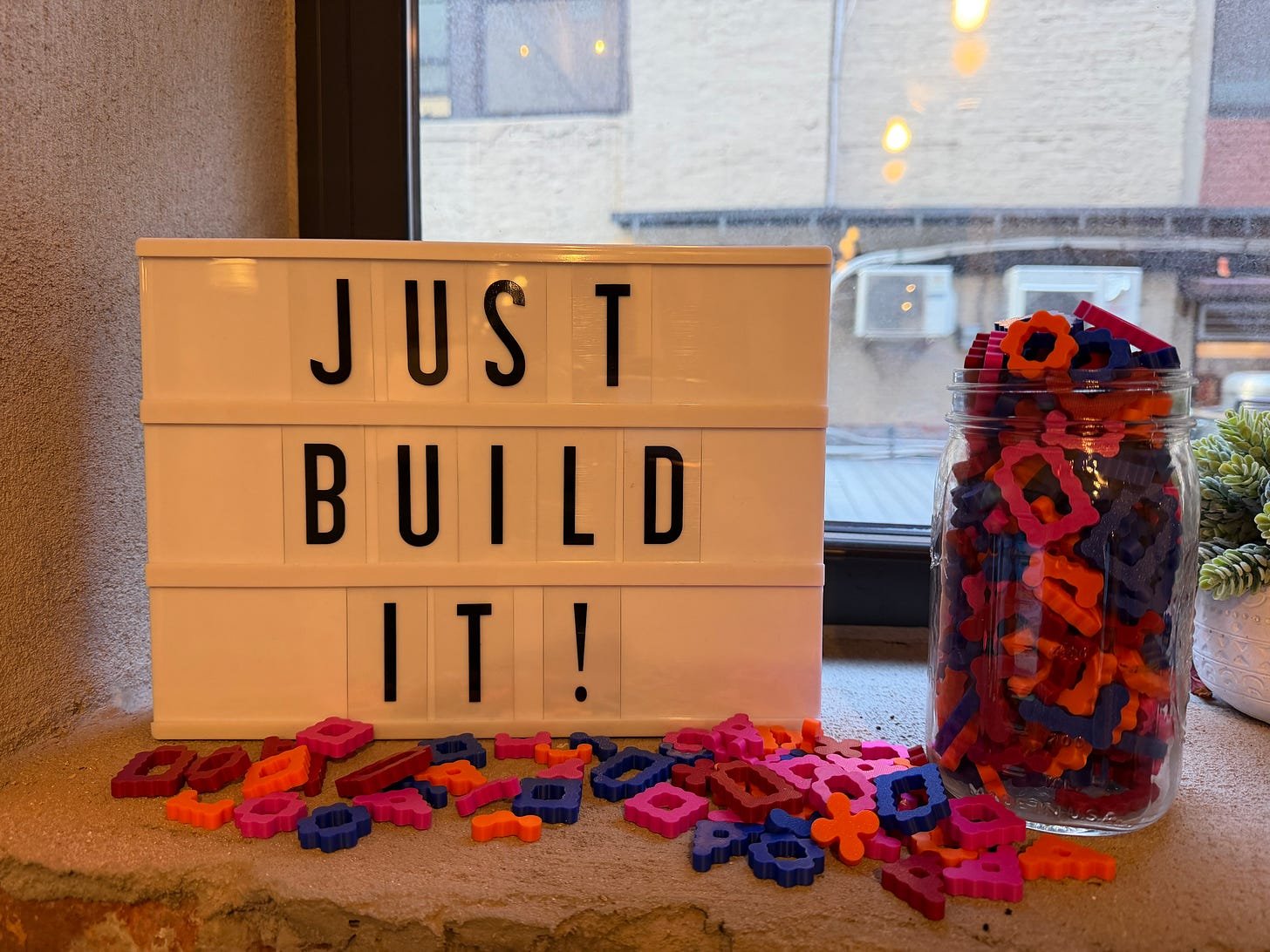
As I tell everyone who comes to a Build First workshop, I feel a little dread all the time. But this week, I felt it particularly hard.
Monday:
Fresh off a trip from San Francisco where I watched early stage robotics companies pilot working prototypes of human-like software, I looked around a room of mostly male developers at a NYC tech meetup, and I wondered what would happen if an entire generation of physical robots were created in the likeness of predominantly one gender.Tuesday
I read Dennis Crowley’s blog post about ending his 17-year tenure as Foursquare’s founder in heartbreak, and I wondered whether to thank the investors who took an early bet on a piece of technology that positively impacted millions of people (myself included), or to resent the process that couldn’t support any economic upside for the employees who quite literally made it possible.Wednesday
I watched the Internet fall apart in 48 hours as millions of bots preyed upon over a dozen cybersecurity vulnerabilities, and I wondered if it would ever feel possible to feel universally connected without feeling unsettlingly vulnerable.Thursday
I dropped my kids off at school and spent the rest of my day wondering what a happy ending might actually look like.Friday
I decide to write my thoughts down.
I was raised not just to believe the world could end, but to expect that it would. Likely, within the span of my lifetime.
Growing up, my brother and I were highly attuned to every negative global, political, or economic crisis as being a potential omen of what’s to come. While I’ve largely learned to suppress that instinct, it can be hard to stay optimistic in the absence of high-integrity leaders amidst increasingly uncertain times.
When I worked at a traditional company, I used to relish the feeling of having a leader or boss send an email after a cataclysmic event, to unify the team, announce a celebration, or acknowledge defeat. I would save these as reminders for the mission and purpose for why I showed up to work each day.
When I worked at Union Square Ventures, while we didn’t have a single CEO, we worked with hundreds of them. I used to wait with anticipation for the forwarded notes that CEOs across our portfolio network would send their employees during times of crisis. I’d save them in a folder in my Google Drive called “Good Examples” and reflect on them when I needed a little bit of courage.
When I started working independently, I stopped getting any emails at all. I started blogging instead.
Most days I write for myself. It’s often the only way I can manage to get an entire thought on paper from start to finish. But other days, I write the note that I wish I’d wake up to in my inbox.
Today is one of those days.
Hello Builders,
No matter where you sit in the weird world of AI, this week has been a lot to take in. There are cybersecurity threats to the digital infrastructure we’ve grown to rely on for decades, performing artists and students pushing back on AI, and predictions that AI agents will outnumber humans 1000 to 1 in just five years.
It’s okay to take a beat to wrap your head around what all of this means.
I’m not going to lie: I woke up this yesterday seriously wondering if my most valuable contribution to society might be to walk away from the computer and have more (human) babies instead. Some friends are seriously considering taking up farming.
It’s tempting to interpret these feelings as proof that the end is near. But instead what if we consider something much simpler (and kinder): That they are proof of our own humanity.
We talk a lot about AI fluency, but we sometimes forget that there’s more to it than perfect prompting. As it turns out, it’s a lot less like learning a tool and a lot more like learning a language: You need to know how to use it, when to use it, and what happens when everyone around you starts using it, too.
After all, we aren’t just learning how to interact with AI individually. We’re learning how to integrate an entirely novel entity in our world. And this takes practice.
Consider this: When you travel to a new city in a foreign country, you can’t get by on words alone. Even with a map and some tips from locals, you will inevitably take a wrong turn, order something you didn’t expect, or even get lost. When we unleash AI agents into an Internet created by humans, who’s to say they won’t do the same thing?
This week, we learned that our digital cities aren’t scaffolded for AI agents to freely roam the streets safely. But we’ve seen this transformation before, when streets designed for horses eventually supported cars, underground subways, and even e-bikes. These change didn’t happen overnight, nor were they particularly comfortable (we’ve all heard stories about horse manure lining city streets).
Throughout each painful technological transformation, we built what came next. And that’s exactly the work in front of us now. Except this time around, the technology might work alongside us to build the solution.
I can’t solve the gender divide in tech or fix the maladaptive financing strategies that fund this ecosystem, just as I can’t single-handedly stop bad human actors from building millions of cyber attack bots. But I can pay forward what I know and help more people become conversationally fluent in the age of AI. And so can you.
Take the time you need today, tomorrow, or whenever that next round of technological anxiety settles into your news feeds. Then teach one person something you figured out this week.
After all, if we’ve learned anything about ourselves as humans over the last several thousand years, it’s that we can’t seem to resist building what comes next.